
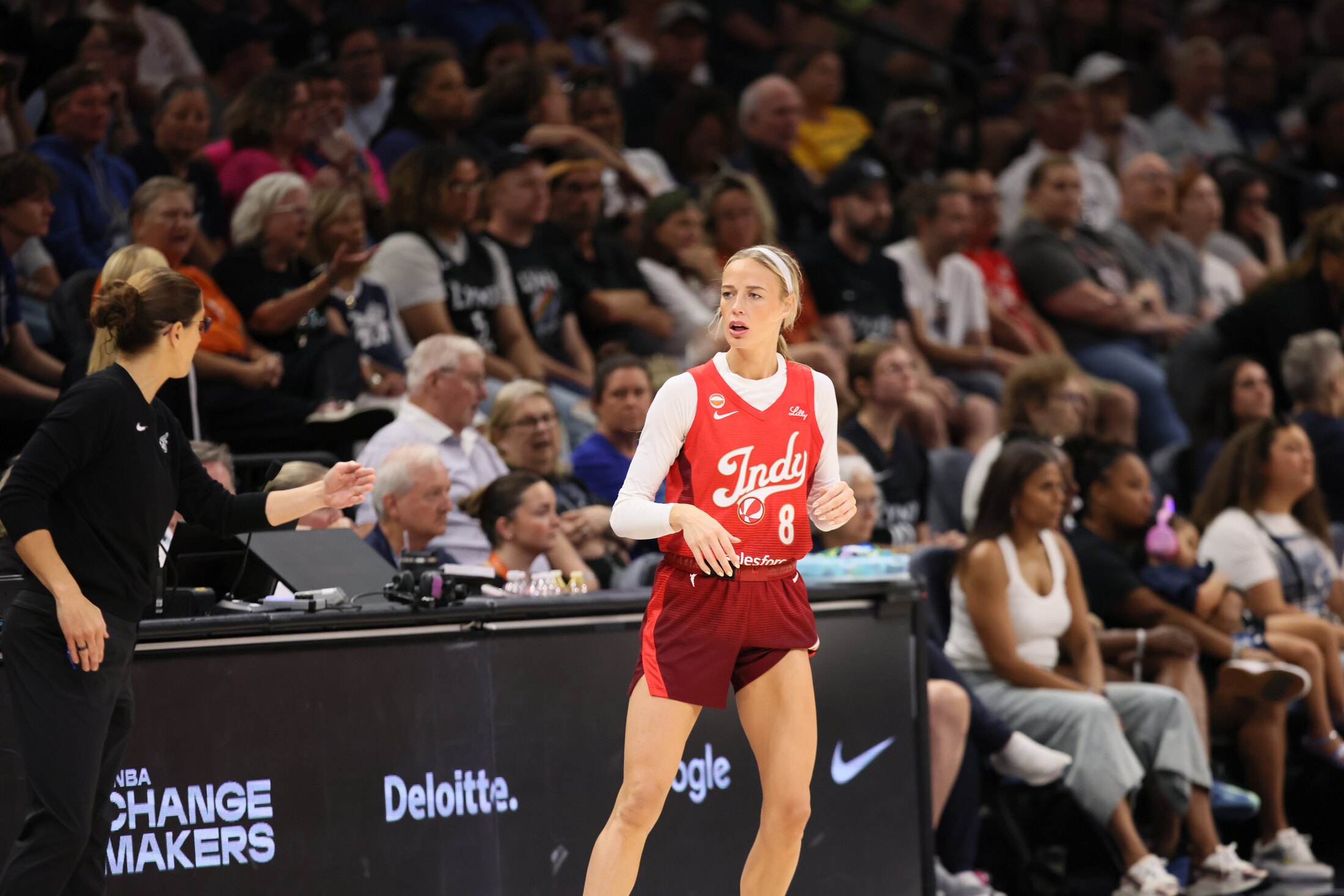
Indiana Fever guard Sophie Cunningham is standing by her position opposing men competing in women’s sports as the response to her remarks continues to grow, both from critics and supporters.
Before the Fever’s July 31 game against the Portland Fire, Cunningham was asked about the demonstrations and public attention surrounding comments she made in a recent ESPN profile.
“I still stand by what I’ve said. I’ll never go back on that.”Sophie Cunningham
She then challenged the WNBA to make room for differing viewpoints within a league that regularly emphasizes diversity and inclusion.
“I think this is a great opportunity for the WNBA,” Cunningham said. “You know, they preach diversity and being inclusive. So what a great opportunity for them to actually be that.”
“We don’t always have to agree,” she continued. “We can still be kind. We can still thrive and be successful in the same area.”
What Cunningham originally said
In the ESPN profile that brought increased attention to her position, Cunningham said she had received negative feedback from people who believed her remarks reflected hatred toward transgender individuals.
“I never once said that,” Cunningham responded. “I think that I am here to extend love. But I also think with that love is truth, being honest.”
She then explained her position.
“I want to protect young girls in a locker room, or young girls in sport who shouldn’t have to go against biological men,” Cunningham said.
Booed in Portland
Cunningham was loudly booed by portions of the Moda Center crowd when she entered the game and at other points while she was on the court.
She finished with 13 points off the bench as Indiana defeated Portland 112 to 98, earning its fifth consecutive victory.
Cunningham said the attention had not distracted her from basketball.
“I’m here to play basketball, but I’m also here to be me,” she said, adding that she would not hide or dim her light because others disagreed with her.
The debate followed the Fever to Minneapolis on Sunday, where Cunningham was again met with boos from some fans. Supporters and counterprotesters also gathered outside Target Center before Indiana’s game against the Minnesota Lynx.
Minnesota defeated Indiana 108 to 100, ending the Fever’s five game winning streak.
Cunningham is not standing alone
Although the boos and criticism have received significant attention, Cunningham’s position also has substantial public support.
A 2025 Gallup survey found that 69 percent of American adults believed transgender athletes should only compete on teams matching their birth sex.
A separate 2026 survey from the Siena Research Institute and St. Bonaventure University found that 58 percent of respondents opposed transgender athletes competing according to their gender identity at the collegiate or professional level. Forty two percent supported such participation.
The surveys used different wording and methodologies, but both found more opposition than support for transgender participation according to gender identity in competitive sports.
Cunningham has also received public support from prominent sports figures.
Former University of Kentucky swimmer Riley Gaines, who competed against transgender swimmer Lia Thomas at the 2022 NCAA championships, publicly supported Cunningham and attended the August 2 game in Minneapolis. Tennis legend Martina Navratilova also publicly backed Cunningham’s position.
Sports commentator Stephen A. Smith defended Cunningham’s position, saying it is unfair to protect a transgender athlete at the expense of biological women.
White House responds
Cunningham’s remarks also reached the White House.
Press Secretary Karoline Leavitt defended the Fever guard during a July 23 press briefing and called the backlash against her “astonishing.” Leavitt said President Donald Trump had not reached out to Cunningham but was following the story.
“Men should not be playing in women’s sports,” Leavitt said, adding that the administration wants to protect women and girls.
President Donald Trump made the issue a stated policy priority when he signed the “Keeping Men Out of Women’s Sports” executive order in February 2025. The order directs federal agencies to oppose male participation in women’s sports as a matter of safety, fairness and equal athletic opportunity.
A continuing national debate
The question of transgender participation in female sports extends far beyond one athlete or one WNBA team.
Athletes including Gaines and former volleyball player Payton McNabb have spent years describing how the issue has affected female competitors. Governing bodies in several sports have also revised their eligibility policies, while state and federal courts have considered challenges involving female athletic categories.
Cunningham’s comments have placed the debate inside one of America’s most visible women’s sports leagues.
Her message, however, is not limited to eligibility rules. It is also about whether people can express conflicting convictions without hostility.
“We don’t always have to agree. We can still be kind.”Sophie Cunningham
Sources and further reading
- Rallies surround Fever and Lynx game after Cunningham’s stanceAssociated Press
- Fever defeat Portland as demonstrations gather outsideAssociated Press
- Cunningham speaks before the Portland gameThe Oregonian and OregonLive via YouTube
- Two thirds prefer birth sex identifications in athleticsGallup
- National survey on sports and transgender participationSiena Research Institute
- Keeping Men Out of Women’s Sports executive orderThe White House
- White House press briefing, July 23, 2026The White House
- White House and sports figures respond to Cunningham’s remarksThe Washington Post
- Stephen A. Smith defends Cunningham’s positionYahoo Sports
- Sophie Cunningham Fever photograph and licenseWikimedia Commons